
The alarm rings, my day is about to start. I must get dressed and go to school. Despite having covered, broken or removed all the mirrors in my room, I still see my image in the window as I put my clothes on. I hate watching myself, but at the same time, I cannot stop doing it. What do I see? A monster! I do not want to leave home. For sure everybody will stare at me, talk about me, laugh on me.
I constantly wonder what did happen. Why have I changed? When I was a girl, I was just perfect, the most clever and beautiful at home, and now? I am horrible. My parents are waiting for me downstairs for the breakfast; they do not know the pain I feel. In their eyes, I see only disappointment and criticism, although, they keep saying I am cute. No doubt they lie to me because they love me: ‘.You are beautiful, you look great in that photo’: I know are all lies.
The school is the worst part, all eyes are on me. ‘Are they looking at my nose or noticing the acne scars that gripped me for a few years?’ They laugh on me (I don’ t see anybody else around whom they might be making fun of, once that there is no other such nasty being like me).
Ok, now it’s time to check if my makeup is still in its place (that must be why they are laughing). Where is the mirror? Ok, let’s take a selfie, making sure nobody is looking at me.
Defects, defects and more defects! I must delete this photo immediately, just in case someone else sees it (let’s be honest: in general, there is nothing worse than photos!)
My lucky friends are perfect: perfect teeth, perfect hair, symmetrical faces: they obviously look gorgeous in the pics. Me? Eyes of different size, greasy skin, huge nose! I always wondered how the left side of my face can be different from the right side. There is nothing to do about it: I am a monster!
I better keep all these thoughts for myself; the last I want is to be judged as another vain and superficial teenager. I just want to stay alone in my room and not to go out anymore (Elena, 16).
For Elena, as for 1-2% of the world population, the mirror has become her worst enemy. They silently suffer from Body Dysmorphic Disorder (BDD). This disorder, usually underestimated, can be mistaken with simple vanity. The worry of being classified as a shallow person stops the people who are affected to talk about the problem and receive the help they need.
This article is addressed to those who feel pain, anguish and suffering when they see their image in the mirror, and despite of that still they do not dare to seek for help. The article should be an interesting reading also for their friends and relatives.
What is exactly the Body Dysmorphic Disorder?
Body Dysmorphic Disorder is related to the concept of self-image. The self-image is the representation we make about ourselves with the information we store throughout our lives. This includes:
– the way we see ourselves;
– how the others see us;
– how we think the others see us.
Along with the self-image, we have the self-esteem (the esteem we have about ourselves). Of course, we all make judgments about who we are; we compare our «real self» with the «ideal self» we have created. The broader the gap between the ideal self and the real one, the lower our self-esteem and self-confidence will be.
Our self-image is the result of the interpretation we make of what we perceive about ourselves; as such it is subjective and not objective concept. The information coming from our mirrored image travels through our nervous system to our brain, and there is where we interpret it and give it a meaning. The meaning is coming from our basic beliefs, experiences and expectations (want to know more about expectations? Click here).
According to Veale (2004), the people suffering from BDD have objectified their body and their being person. Thus, they see themselves as aesthetic objects and not as a person. The self-image is limited only to that part of the body they detest. The attention is selective, they look only the flaws.
By perceiving defects in the outside, they have the mistaken idea that by changing this part (with plastic surgeries for example) they can finally have peace. However, this state of ideal beauty is never reached: commonly, after the first surgery they will find another defect, since the problem lies not in the body, but in how they perceive their body. The idea of having a physical defects causes them an excessive worry, although often these defects are imaginary, or their concern is more intense than expected.
How and why does the BDD start?
Body Dysmorphic Disorder has its onset, in most cases, during the adolescence. It is linked to an increase of concern about appearance. A specific cause has not yet been discovered, so it is considered as being the result of several factors, including:
- Abuse experiences, violence and abandonment, especially humiliations related to their appearance.
- Being or have been victims of bullying, isolation or social rejection.
- Have reference figures (parents, teachers or coaches) hypercritical and perfectionists
- Family history, i.e., close relatives also suffering from BDD
- Low self-esteem
- Having perfectionist, introverted and/or anxious personality traits.
- Have a history of physical and/or dermatological problems.
How BDD is maintained with time?
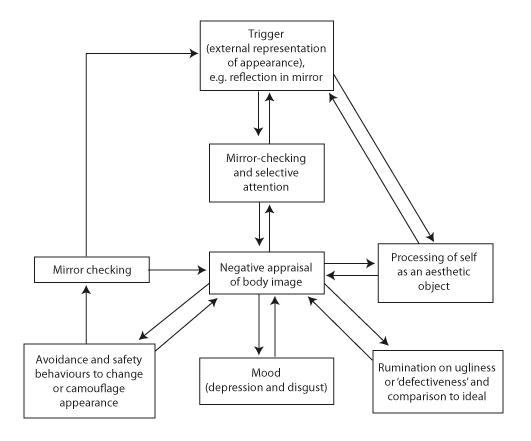
According to Veale (2004), an external event (such as looking at the reflection of their selves in a mirror or a window, or listening to the others laughing) triggers the urgency to check if the «defects» are visible to the others. However, their selective attention focuses only on the aspects that they consider as defects (their noses, new pimples, etc.). The study of their own bodies – as if it were an object – leads the people to make a negative evaluation of it, affecting the state of mind. Negative evaluation is difficult to stop – rumination – as it is usually reinforced by a tendency to compare themselves with others.
The distorted perception of the body triggers also avoidance behaviors (as not going to school, do not leave their bedroom, leaving the classroom, etc.) or desperate attempts to camouflage the face or body with make-up or clothing. The mirror should then allow them to check if they have achieved the goal; however, this is just the beginning of a new cycle.
People with BDD can develop obsessive-compulsive behaviors or rituals (looking in the mirror, taking pictures and then erasing them, getting facial cleansing). Many of these behaviors will relieve temporarily the anxiety, but with the high cost of reinforcing the dysfunctional beliefs about an imperfect physical appearance. Because of this trait, the BDD has been included in the «obsessive compulsive spectrum».
Let’s observe this cycle in the following scheme (Veale, 2004):
Is BDD risky?
The major risks that can arise in people suffering from BDD are:
- Low self-esteem: Due to a personal worth bounded to the perception of their appearance and a tendency of being self-critical and self-demanding, which will impact directly their self-esteem.
- Increase in avoidant behaviors: Since it is a common avoidant behavior to stop going out with friends or not wanting to go to school any more, they can fall in deep isolation and loneliness.
- Comorbidity with other disorders: BDD is not simple vanity. Its complexity and tendency to becoming chronic has drawn attention of researches all over the world. BDD can trigger other disorders such as depression, social anxiety, eating disorders, obsessive-compulsive disorder, personality disorders, etc. In addition, there is a high risk of suicide and/or self-destructive behaviors.
Elena thoughts are similar to mine: What can I do?
Seek for help. An early diagnosis and intervention is the key to regaining the ability to love and accept yourself.
Cognitive behavioral therapy (CBT) has shown good results in treating this type of disorder. CBT focuses on the analysis and dysfunctional thoughts restructuring and includes exposure exercises and avoidant behaviors prevention. In some cases, depressive symptoms or other disorders may present together with the BDD; if needed, a psychiatrist can include a pharmacological treatment.
You are a friend or relative of Elena. Can you help her?
Of course. You can:
- Recognize and accept her feelings without judging. You should not try to convince her that she has no defects (on the other side do not ridicule her concerns as mere vanity or self-centeredness).
- Being open to talk. Active and empathetic listening can be very helpful. Letting her express fears, anguishes and emotions, will give her relief.
- Celebrate her achievements (i.e. when breaking the cycle, changing her thoughts, stopping her rumination process or facing openly her fears) Always respect her spaces (sometimes she will just feel as being on her own)
- Read and understand more about BDD. What situations trigger a crisis? You can accompany her to face each trigger under the supervision of the therapist.
- Motivate her do the things she enjoys and which are not related with physical appearance. This will bring to positive reinforcements that will improve her self-esteem.
- Join her in the search for professional help. Also, if you feel as you need, do seek for support as well. As a matter of fact it can be stressful to take care of a relative or friend with BDD. There are family support groups where you can share your own fears and frustrations.
References:
Veale, D. (2004). Advances in a cognitive behavioral model of body dysmorphic disorder. Body Image, 1, 113-125.
 mipsicologiaonline