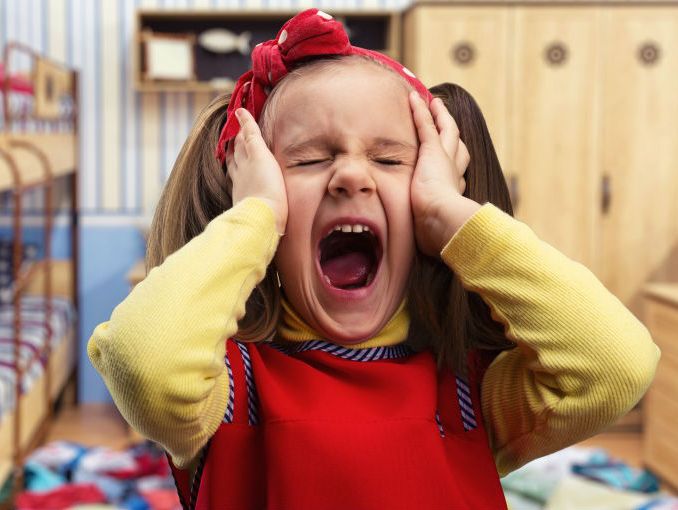
What is anger?
Anger is a fundamental emotion. It produces an increase of the blood pressure, the raise of those neurotransmitters linked to stress and the lowering of the ones related to pleasure. As an emotion, it has a beginning and an end.
It is also an instinct, a spontaneous force that invades the child pushing him/her to defense.
Anger is an ally. It is a form of self-assertion; it helps to increase self-esteem, not to give in to abuses and humiliations. It is a way to ask for help, a defense tool, a signal that the child is suffering. It is a tool to test the limits and understand how much damage he/she can do to others.
It is a request for love and attention.
How to deal with it?
Keep calm.
In practice: keep the child in a safe place while venting anger, without reproaching or yelling; wait patiently for him/her to calm down on his/her own. Seeing that we do not get angry ourselves helps to reduce the gravity of the event and reassures the child.
Get closer.
Pampering, hugs, caresses, smiles and kind words make oxytocin levels rise, this hormone in fact counteracts stress and is present in states of pleasure and contentment.
What about screams and kicks?
The child who goes into a fever should not be repressed: when he/she feels anger to be unloaded it and instinctively the way this happens is through the body. Therefore, it should be encouraged to let off steam; same strategies can be: quickly jumping on the spot counting, taking a run in the yard, throwing a pillow on the floor or trimming a blow to the mattress.
Do not label children
Avoid the temptation to label your child as angry and/or short-tempered. It is important to understand the state of mind that lies beneath that behavior.
Do not respond to anger with more anger
Screaming will generally increase his/her anger levels; it might also frighten the child and diminish trust in the parents.
Do not leave an angry child alone.
Stay close and provide assurance (unless the child explicitly does not want it). After the outburst, talk about it to encourage the ability to listen to yourself and your emotions. It can be good to encourage him/her to identify this emotion in a real-life character, for example, «the Mad Lady».
Counting.
Helps to calm down both large and small. Stand next to the child and count with him/her until the anger is gone. Always use a serene tone.
Breathing.
Take deep breaths. The child will also learn to breathe as a strategy to manage anger
The basket of anger.
- Choose a basket, a box or a big jar that you will use exclusively for this purpose.
- Choose a specific place where you can store the rage basket.
- Whenever the child is angry, ask him/her to draw his anger on a piece of paper.
- When the anger moment is over, discuss the drawing together.
- Ask him/her to crumple the paper and throw it in the basket of anger.
- Try to make him/her express the emotions he is experiencing after venting all his anger.
Other strategies
Relaxation
Mandala for children
Zen garden
Construction and use of sensory balls
Books and fairy tales
The relaxing corner.
The relaxing bottle
Errors (Do not…)
Get angrier than him/her
Smother the emotion.
Try to make him/her think
Punish severely
Tease him/her
 mipsicologiaonline